
The short answer
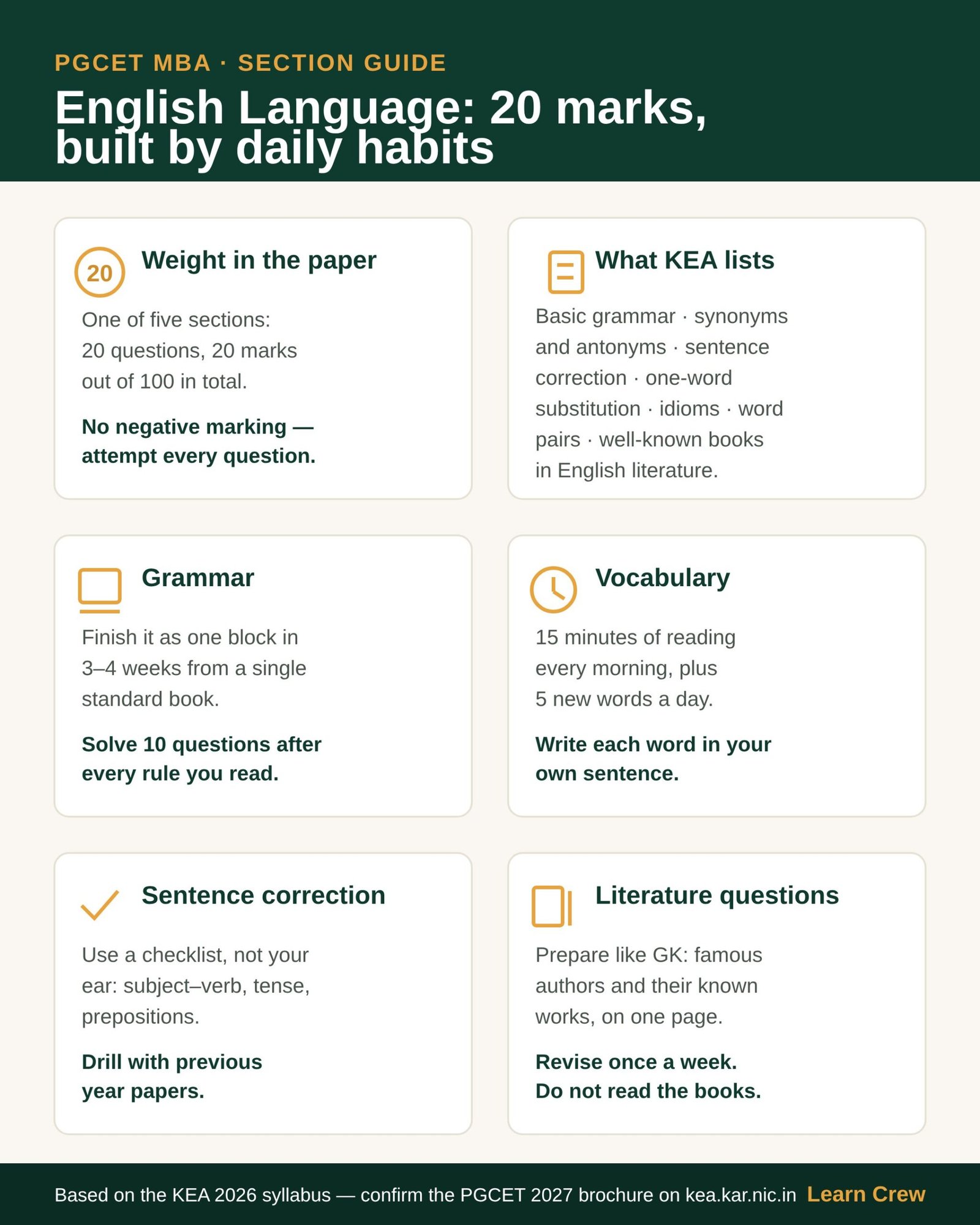
English Language is one of the five sections in the Karnataka PGCET MBA paper, with 20 questions for 20 marks. The syllabus KEA published for the 2026 exam lists basic grammar, synonyms, antonyms, sentence correction, one-word substitution, idioms and phrases, word pairs that express a relationship, and questions on well-known books in English literature. There is no negative marking anywhere in the paper, so you attempt every question.
One caution before anything else. KEA has not released the PGCET 2027 brochure yet, so this guide works from the official 2026 syllabus. When the 2027 notification appears on kea.kar.nic.in, read the English section list once and confirm nothing has changed.
Where English sits in the paper
The MBA test is one objective paper of 100 questions for 100 marks, and in recent cycles it has run for 120 minutes. The five sections carry 20 questions each — our PGCET MBA syllabus guide walks through all five. English matters for a quiet reason: it is usually the fastest section to finish. A prepared student clears it in 12 to 15 minutes, and every minute saved here goes to the puzzles and calculations waiting in reasoning and quant. So the goal in English is not just marks. It is marks plus time.
Grammar: finish it as one block
Grammar is the only part of this section you can actually complete. The rules do not change, and the paper tests the same families again and again: subject-verb agreement, tenses, prepositions, articles, and the correct use of common parts of speech. Take any one standard grammar book and finish it in three to four weeks as a focused block. Do not read rules passively — after each rule, solve ten questions on it the same day. A rule you have applied sticks; a rule you have only read fades by Friday.
Vocabulary: the daily habit that fills half the section
Synonyms, antonyms, one-word substitution and idioms together form the biggest chunk of the section, and all of them are really one skill: words you know. Vocabulary does not grow in a weekend. It grows at the rate of a few words a day, held for months. The routine is simple. Read one newspaper editorial every morning — fifteen minutes is enough. Note five new words, write each in your own sentence, and keep the list on your phone. Revise the list while commuting. For one-word substitution and idioms, standard lists exist in every PGCET book; learn a page a week and recycle old pages on Sundays.
The syllabus also mentions word pairs that express a relationship — analogy-style questions where you pick the pair that behaves like the given pair. These cost nothing extra: the same vocabulary work answers them, plus a habit of asking “what connects these two words?” before looking at the options.
Sentence correction: a method, not a mood
Most students answer sentence correction by feel — whichever option “sounds right”. Sounding right fails under exam pressure. Use a fixed checklist instead. Read the full sentence once. Find the verb and check it against its subject. Check the tense against the time words in the sentence. Check every preposition. If two options differ by a single word, the question is only about that word — test it and ignore the rest. The fastest way to learn the patterns KEA actually uses is to work through PGCET previous year papers and keep a notebook of every error type that caught you.
The literature question: prepare it like GK, cheaply
The odd item on the list is well-known books in English literature. Do not over-invest here. Nobody expects you to read the books. Treat it as general knowledge: famous authors and the works they are known for, celebrated classics, and well-known Indian writing in English. Keep it to one page of notes, built over a few weeks, revised once a week. If a question comes, it is quick marks; if it does not, you have lost almost no time preparing.
A simple daily routine
This section rewards small daily effort more than any other. Twenty to thirty minutes a day is enough: fifteen minutes of reading, five new words, and ten practice questions, alternating grammar one day and vocabulary the next. Once your grammar block is done, add one timed sectional test every week and hold yourself to fifteen minutes for twenty questions. And remember the rule the paper gives you free: there is no negative marking, so an educated guess always beats a blank bubble.
From section marks to a seat
A strong English section protects your rank on a bad day. Quant can wobble and a puzzle can eat your time, but the twenty English marks stay stable if the habits above are in place. Once your full mock scores settle into a range, our free PGCET rank and college predictor shows what that range turned into as a rank and a college list under KEA’s 2025 first-round cut-offs — an estimate from last year’s data, not an official figure, but a useful early signal.
If you want structured preparation across all five sections, see our PGCET online coaching for MBA and MCA. Classes are live three evenings a week — Monday, Wednesday and Friday, 6:30–8 PM IST — every class is recorded, and e-books, mock tests and one-on-one mentorship are included. Admissions are rolling, so you can join in any week and your four-month cycle starts then. Fees are ₹10,000 for MBA, ₹12,000 for MCA, and ₹4,000 for recorded-only access. In PGCET 2025 our students reached a highest State Rank of 23, with 70 students under rank 1000, and in PGCET 2026 a highest State Rank of 89 — the details are on our results page.
Start tonight: one editorial, five words, ten questions. The section is twenty marks, and it is the most patient twenty marks on the paper.
PGCET books, e-books and mock tests
The PGCET MBA book set and the PGCET MCA book set are printed A4 and couriered across India. The e-books and the scored mock test series are on the same store pages, so you can pick print, digital, or both.