
The short answer
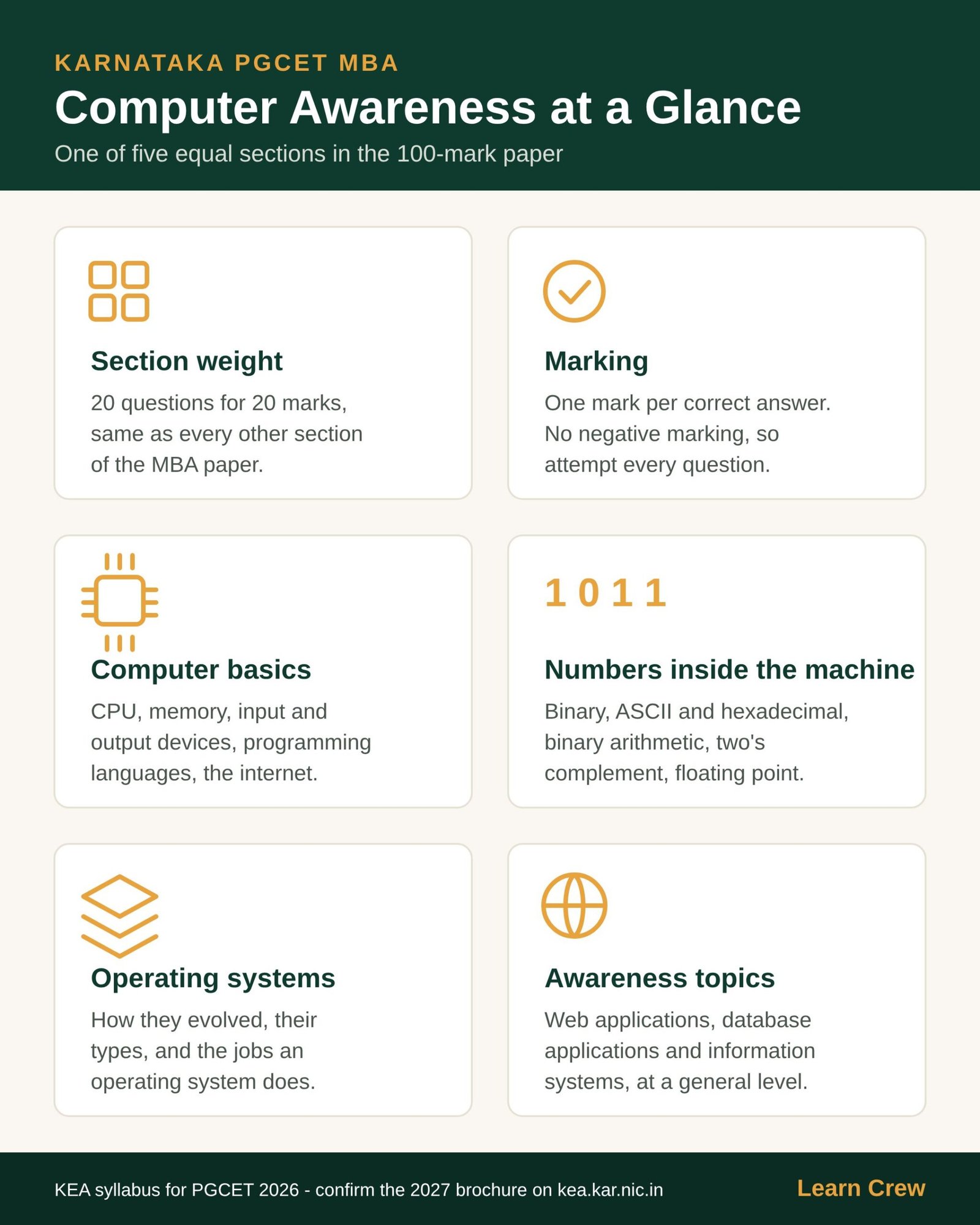
Computer Awareness is one of the five sections in the Karnataka PGCET MBA paper, with 20 questions for 20 marks. The syllabus KEA published for the 2026 exam covers computer basics, data representation, binary arithmetic, and operating systems, along with general awareness of the internet, web applications, database applications and information systems. There is no negative marking anywhere in the paper, so you attempt every question. And here is the part most students miss: this is the most learnable section of the five, because almost every question tests something you can simply study and remember, not something you must solve under pressure.
One caution before anything else. KEA has not released the PGCET 2027 brochure yet, so this guide works from the official 2026 syllabus. When the 2027 notification appears on kea.kar.nic.in, read the Computer Awareness list once and confirm nothing has changed.
Where the section sits in the paper
The MBA test is one objective paper of 100 questions for 100 marks, and in recent cycles it has run for 120 minutes. The five sections carry 20 questions each — our PGCET MBA syllabus guide walks through all five. Two things make Computer Awareness special. First, it needs no speed: there are no long calculations and no puzzles, so a prepared student clears it in ten to twelve minutes and carries the saved time into quant and reasoning. Second, it is not a technical test. You do not need an engineering or computer science degree. The questions sit at the awareness level, and a commerce or arts graduate who studies the list below can score as well as anyone.
Computer basics: the biggest block
The first family in the syllabus is the organisation of a computer: the Central Processing Unit, input and output devices, computer memory, programming languages, types of operating systems, and general awareness about the internet. Study it the way you study general knowledge, but with a little understanding behind each fact. Make one page of notes per topic. Know the units of memory in order, from bit and byte upwards. Keep a short list of input devices, output devices, and devices that do both. Know what a programming language is and the common names. Most questions from this block are direct one-liners — if the fact is on your page, the mark is yours.
Numbers inside the machine
The second and third families are data representation and binary arithmetic: how characters, integers and fractions are represented, binary, ASCII and hexadecimal forms, addition, subtraction, multiplication and division in binary, two’s complement, and floating-point representation including the normalised form. These are the only questions in the section that look like mathematics, and they are friendlier than they look, because every one of them follows a fixed procedure. Converting decimal to binary is the same five steps every time. Two’s complement is the same two steps every time. Give this family ten minutes of practice a day for two or three weeks — convert a few numbers between decimal, binary and hexadecimal, add two binary numbers, take one complement. After that, these marks never slip.
Operating systems and the awareness topics
The last family is operating systems: how they evolved, their types, the functions an operating system performs, and a feel for modern operating systems. Alongside it sit the awareness topics — web applications, database applications and information systems — which only ask what these things are, where they are used, and the basic terms around them. Any standard PGCET book covers both in a few short chapters. The smartest extra step is to work through PGCET previous year papers, because this section repeats its question families more faithfully than any other part of the paper. A notebook of every repeated question type is worth more here than a thick textbook.
A simple three-week routine
Give the section three focused weeks. Week one: computer basics — one topic a day, one page of notes a day. Week two: number systems — notes in the first half of the week, then daily conversion and arithmetic drills. Week three: operating systems and the awareness topics, plus your first timed sectional test. From then on, one twenty-question sectional a week, held to fifteen minutes, and a Sunday revision of all your pages. Twenty to thirty minutes a day is enough. And remember the rule the paper gives you free: there is no negative marking, so an educated guess always beats a blank bubble.
From section marks to a seat
A strong Computer Awareness section is rank insurance. Quant can wobble on a hard day and a puzzle can eat your time, but these twenty marks stay stable once the notes and drills are in place. When your full mock scores settle into a range, our free PGCET rank and college predictor shows what that range turned into as a rank and a college list under KEA’s 2025 first-round cut-offs — an estimate from last year’s data, not an official figure, but a useful early signal.
If you want structured preparation across all five sections, see our PGCET online coaching for MBA and MCA. Classes are live three evenings a week — Monday, Wednesday and Friday, 6:30–8 PM IST — every class is recorded, and e-books, mock tests and one-on-one mentorship are included. Admissions are rolling, so you can join in any week and your four-month cycle starts then. Fees are ₹10,000 for MBA, ₹12,000 for MCA, and ₹4,000 for recorded-only access. In PGCET 2025 our students reached a highest State Rank of 23, with 70 students under rank 1000, and in PGCET 2026 a highest State Rank of 89 — the details are on our results page.
Start tonight: one page of notes on the CPU, and one decimal number turned into binary. The section is twenty marks, and it is the most patient twenty marks on the paper.
PGCET books, e-books and mock tests
The PGCET MBA book set and the PGCET MCA book set are printed A4 and couriered across India. The e-books and the scored mock test series are on the same store pages, so you can pick print, digital, or both.