
What happened this week
Karnataka has released draft rules to regulate coaching centres and tutorial institutions across the state. The draft, called the Karnataka Tutorial Institutions or Coaching Centre (Registration and Regulation) Rules, 2026, was notified by the higher education department on Wednesday, 28 October 2026, as reported in the press. It is meant to replace the old rules from 2001.
One word matters here: draft. These are proposals, not law yet. The public can send recommendations within 15 days of the draft’s publication, and the final rules can look different. So read everything below as “what the state wants to do”, not “what is already in force”.
Who the draft covers
The draft defines a coaching centre as a centre run by any person to provide coaching for any study programme or competitive exam for more than 20 students. Tutorial institutions — tuition classes, academic support centres and similar set-ups — are treated the same way. In short, almost any organised paid coaching of a reasonable size would come under these rules once they are final.
Rules that protect school students
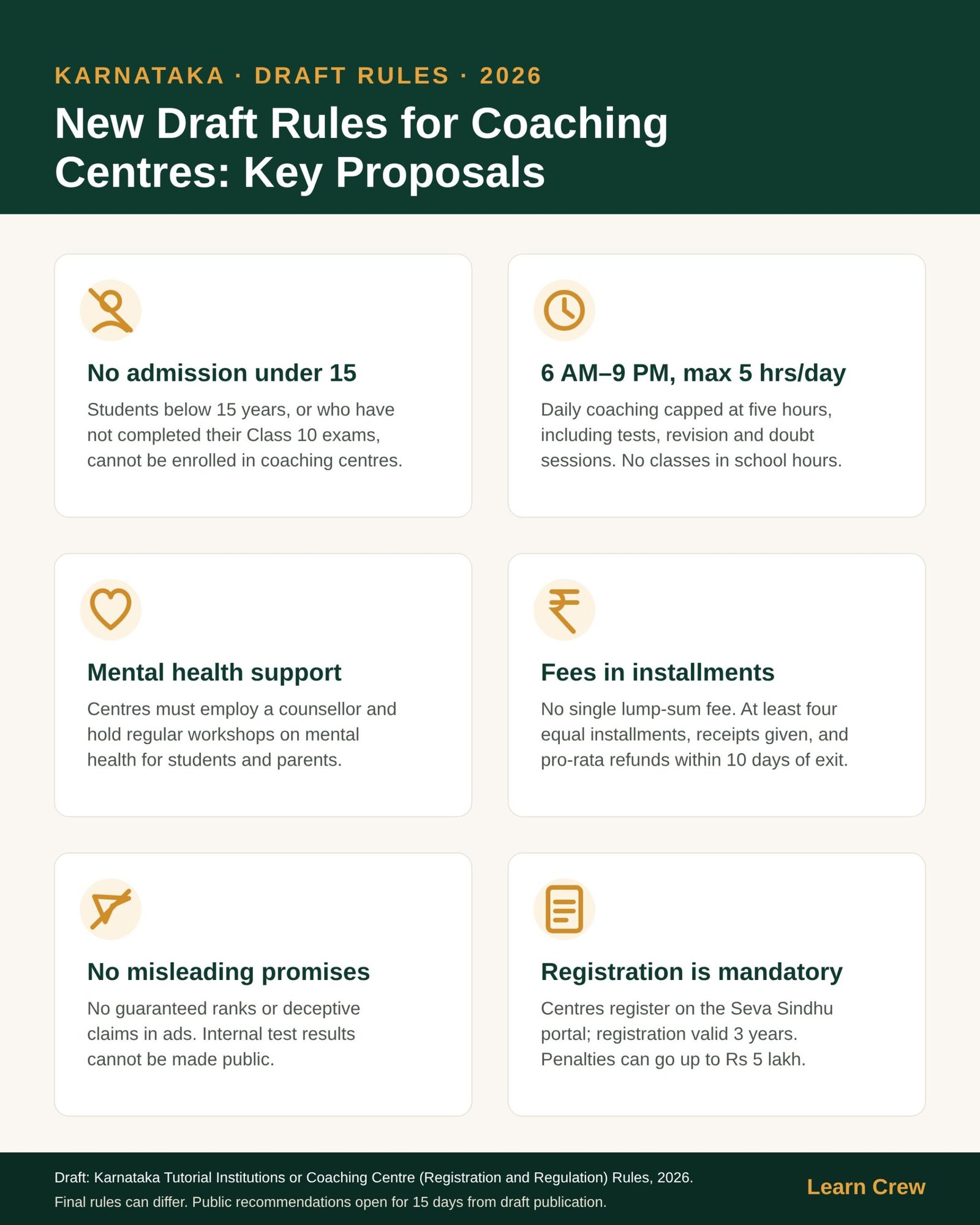
The strongest parts of the draft are aimed at school-age children. Centres would not be allowed to admit students below 15 years of age, or students who have not completed their Class 10 exams. Daily coaching would be capped at five hours, and that cap includes tests, revision and doubt-clearing sessions, not just lectures. Classes could run only between 6 AM and 9 PM, and not during regular school or college hours.
There is also a clear push on mental health. Every centre would need a mental health counsellor, and would have to run periodic workshops for students and for parents. Tutors would be trained to talk about weak areas without piling on pressure, and students would be told about other career options so one exam does not feel like the whole future.
Your money: fees, installments and refunds
This part matters at every age, including MBA aspirants. Under the draft, a centre cannot collect the full course fee as one lump sum. It must offer payment in at least four equal installments, keep fees fair, and give receipts. If a student drops out early, the centre must refund the fee for the remaining period on a pro-rata basis within 10 days. Hostel and mess fees would have to be refunded promptly too.
If that survives into the final rules, it changes the risk of joining any coaching programme. Today, a student who pays a year’s fee and leaves in month two often loses most of it. The draft puts a clock and a formula on that refund.
No misleading promises
The draft bans misleading advertisements, guaranteed-rank promises and deceptive claims about results or faculty. It also says assessment test results cannot be made public, inside or outside the centre — they are to be used only for analysing student performance. The idea is simple: marketing should not manufacture pressure, and a student’s test score is not a billboard.
Registration, penalties and oversight
Every centre would have to register through the Seva Sindhu portal, with a geotagged location of its premises, and each branch counted as a separate institution. The reported registration fee is Rs 15,000 plus Rs 5,000 for each course, with the district deputy commissioner as the registering authority and a three-year validity. Unregistered centres operating beyond six months face sealing, and serious non-compliance can draw penalties of up to Rs 5 lakh. Two district-level monitoring committees — one for Bengaluru Urban, one for the rest of the state — would oversee compliance.
What this means if you are preparing for PGCET
If you are a PGCET MBA or MCA aspirant, you are a graduate, so the age rules are not about you. But the spirit of the draft is very much about you, because it describes what fair coaching should look like at any level: clear fees, receipts, installment options, honest claims and no pressure tactics.
So use it as a checklist before you pay anyone — including us. Ask for the full fee in writing and whether installments are possible. Ask what happens to your money if you leave mid-way. Treat any guaranteed-rank claim as a red flag, because no honest teacher controls your rank. And check results that can be verified, not posters. If you are starting your own preparation journey, our PGCET 2027 preparation plan shows what the months ahead look like, and our PGCET 2027 eligibility guide answers the who-can-apply questions.
A note for parents
If you are a parent reading this, the draft gives you language for questions you may have hesitated to ask. How many hours will my child actually sit in class? Who do I speak to if something feels wrong? Is there a complaint box, and is the fee receipt real? The draft also asks centres to counsel students whose performance is dropping, instead of quietly ignoring them. None of this needs you to wait for the final rules — these are fair questions to ask any institute today.
Where to go next
If you want structured preparation, see our PGCET online coaching for MBA and MCA. Classes are live in the evenings, every class is recorded, and e-books, mocks and mentorship are included. Our fee, installment and refund terms are stated plainly before you join, and our results are public and verifiable — a PGCET 2026 high of State Rank 89, and in PGCET 2025 a high of State Rank 23 with 70 students under rank 1000. And if you already have a PGCET 2026 score and are weighing colleges, our free PGCET rank and college predictor gives an estimate built from KEA 2025 first-round cut-offs — the official position is always on kea.kar.nic.in.
PGCET books, e-books and mock tests
The PGCET MBA book set and the PGCET MCA book set are printed A4 and couriered across India. The e-books and the scored mock test series are on the same store pages, so you can pick print, digital, or both.