
What this section is in MAT
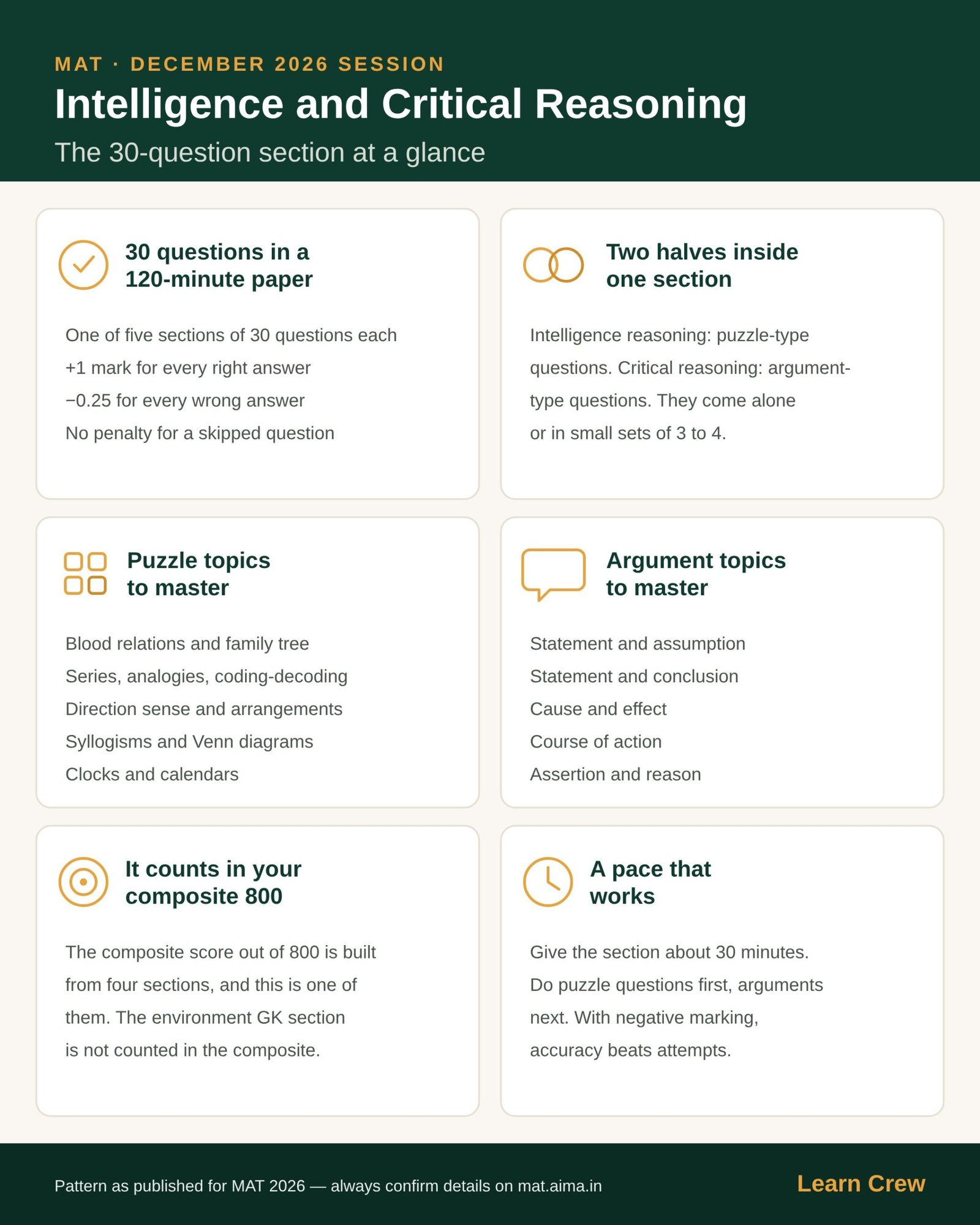
MAT has five sections, and Intelligence and Critical Reasoning is the reasoning section. The paper has 150 questions in total, 30 from each section, and you get 120 minutes for the whole test. Every correct answer gives you 1 mark, and every wrong answer takes away 0.25. A skipped question costs nothing. The composite score, the one reported out of 800, is built from four sections, and this section is one of them. So the marks you earn here go straight into your final score.
The name itself tells you something useful. AIMA treats this section as two parts in one. Intelligence reasoning is the puzzle part — series, family trees, codes, seating. Critical reasoning is the argument part — statements, assumptions, conclusions. The two parts need different skills, and students who prepare them as one blob usually do well in one half and bleed marks in the other. Questions can come one at a time or in small sets of 3 to 4 built on the same data.
The topics the 30 questions come from
AIMA does not publish a question-wise break-up, and the mix shifts a little from paper to paper. But past papers keep drawing from the same pool. On the puzzle side: blood relations and family tree, number and letter series, analogies, coding-decoding, direction sense, linear and matrix arrangements, syllogisms, Venn diagrams, clocks and calendars. On the argument side: statement and assumption, statement and conclusion, cause and effect, course of action, assertion and reason, and short passages that ask what follows. If you want the topic lists for all five sections in one place, our MAT syllabus guide covers them section by section.
Win the puzzle half first
Puzzle questions look clever, but almost every type has a fixed method. Blood relations become easy the moment you draw the family tree instead of holding it in your head. Series questions fall to two checks — constant differences, then alternating patterns. Coding questions are mostly letter positions and simple shifts. Direction questions need a rough map on paper, nothing more. Arrangement questions need a small table you fill line by line.
Learn the method for one topic, solve twenty questions of that type, and the next one takes you under a minute. That is the whole trick. The puzzle half is where your speed and your safe marks come from, so build it first. None of this needs any formula beyond school-level logic — it needs repetition.
How to read arguments in critical reasoning
The argument half is a different game. Here the test is careful reading, not speed. A few rules keep you safe. First, accept the statement as true even if it sounds odd — the question is about the logic, not about the real world. Second, an assumption is something unstated that must hold for the argument to work; if the argument survives without it, it is not an assumption. Third, a conclusion must follow only from what is given. The most common trap in this half is using your own general knowledge to pick an answer the passage never supports.
For cause and effect, ask which event came first and whether both could come from some third cause. For course of action, ask two things: does it actually address the problem, and is it practical? An action can sound noble and still fail both checks. Give these questions a slow, full reading. Saving ten seconds here is how wrong answers happen.
A 30-minute plan inside the paper
You are free to divide the 120 minutes across sections as you like, and about 30 minutes is a fair share for this section. Work in two passes. In the first pass, pick off the puzzle types you have practised — aim at 60 to 90 seconds each — and skip anything that looks like a long set. In the second pass, do the argument questions with a careful reading, then return to the sets you marked. Skipping costs nothing, and a wrong answer costs 0.25, so with this section accuracy beats attempts every time. Practise the two-pass habit under a running clock — our MAT mock test strategy explains how to turn mock scores into a plan instead of a mood.
A simple routine before the December exam
The December 2026 session has been announced with the paper-based test on 20 December and the computer-based test on 27 December. Registration is open — always confirm the dates and the last date to apply on mat.aima.in before you plan. That leaves roughly six to seven weeks from today, which is enough for this section if you are steady.
A workable weekly routine: pick three puzzle topics and one argument type each week. Learn the method on day one, then solve small timed sets of 10 to 15 questions on alternate days. Once a week, sit a full 30-question sectional test in 30 minutes and note which topics ate your time. In the last two weeks, shift to full mocks so the section sits inside the real 120-minute pressure, not outside it.
Mistakes that cost marks here
Four mistakes appear again and again. Preparing the puzzle half and walking into the argument half cold. Using outside knowledge in critical reasoning instead of the passage. Sitting on one stubborn puzzle set for five minutes while easy questions wait unseen. And guessing blindly at the end — with negative marking, a string of blind guesses can quietly erase a good section.
Where to go next
If you want this section — and the other four — prepared under guidance, see our MAT online coaching for 600+. Classes are live in the evenings, every class is recorded, and mocks and mentorship are included. For what past students have managed, our results are here — a MAT high of 771/800, with 9 of 10 students crossing 600.
MAT books, e-books and mock tests
The MAT book set covers Logical, English, Mathematics and Data Interpretation, printed A4 and couriered across India. The e-book and the scored mock series are on the same store, so you can pick print, digital, or both.