
The short answer
Yes – you can prepare for the Karnataka PGCET while you are still finishing your degree, and join an MBA or MCA in the same year you graduate. PGCET for final-year students works on one simple idea: build the habit through the academic year, write the exam after your last semester, and report for counselling once your results are out. In 2026 the exam was held on 14 June, so the whole cycle fits neatly after final-year exams.
One caution before anything else. KEA has not announced the PGCET 2027 schedule yet. Everything in this guide works from the 2026 cycle, and every date for 2027 is expected, not confirmed. When the official notification appears on the KEA website (kea.kar.nic.in), check it once and mark your own calendar.
Last reviewed: 16 November 2026.
Can final-year students write the Karnataka PGCET?
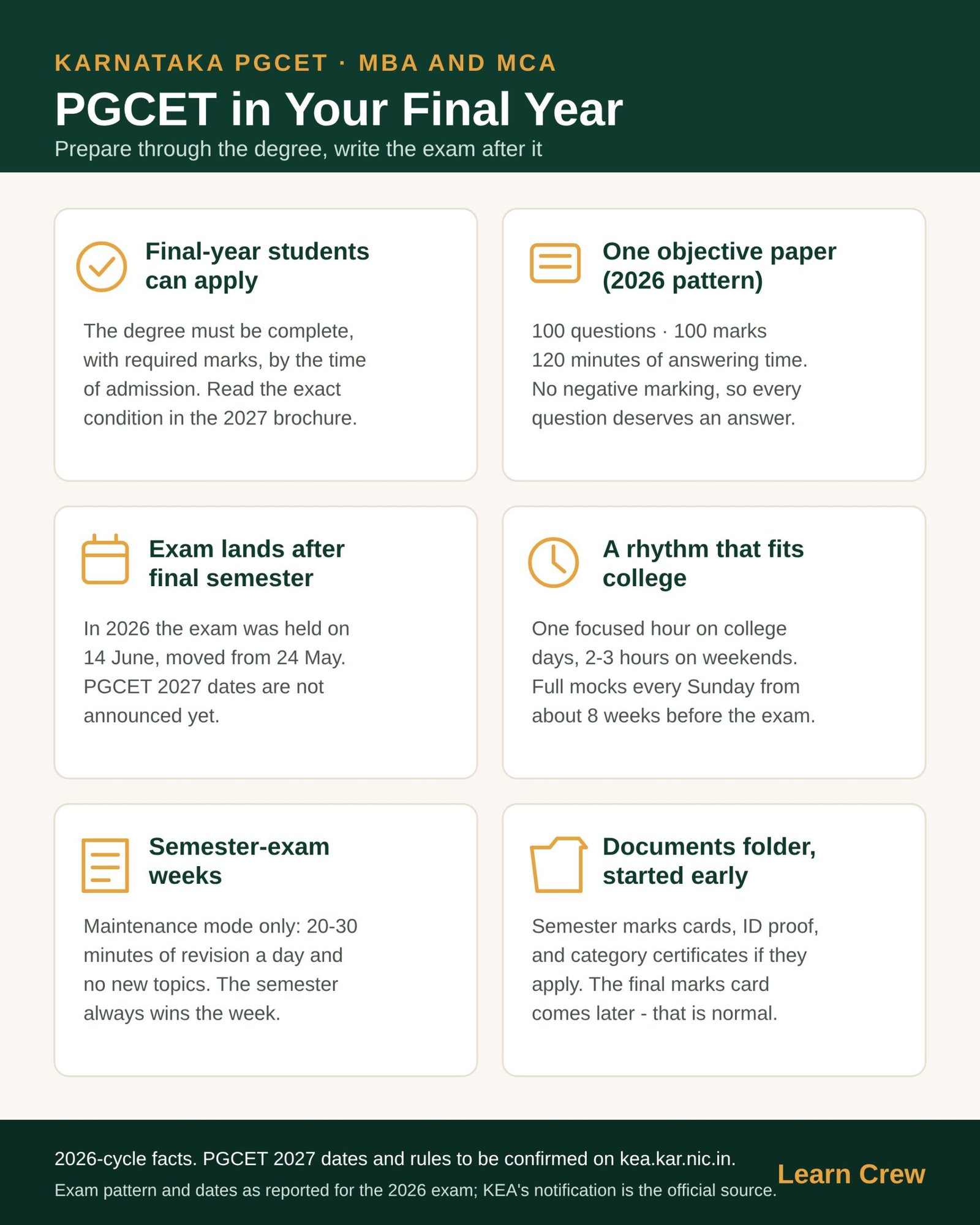
Final-year students can write the PGCET. The usual condition is that your degree must be complete, with the required marks, by the time of admission – you sit the exam first and submit the final marks card later in the process.
The exact wording of this condition sits in each year’s KEA brochure, so read it once when the 2027 notification is out. For the full picture of degrees, marks and categories, see our guide on who can apply for PGCET 2027. If you clear eligibility, final year is actually the best time to attempt: your study habit is still alive, and you lose no year between degree and post-graduation.
PGCET for final-year students: how the year looks
PGCET for final-year students runs on two calendars at once – your college calendar and the exam calendar. The table below lines them up, using the 2026 cycle as the map. KEA has not announced the 2027 dates, so treat the exam column as expected and confirm it on kea.kar.nic.in when the notification arrives.
| Months | Exam cycle (2026 pattern) | You, in final year |
|---|---|---|
| November to January | Quiet period; 2027 notification awaited | Daily basics: maths, English, reasoning, news |
| February to April | KEA opens registration on its website | Fill the form early; start weekly mocks |
| May to June | Exam window – held on 14 June in 2026, moved from 24 May | Degree exams end; full revision, then the exam |
| July to September | Result, then KEA counselling rounds | Collect marks cards; option entry and seat choice |
Notice the one clash in the whole plan: the exam window and your degree exams sit close together. The sections below deal with exactly that.
What does the PGCET paper ask of you?
The PGCET MBA paper is one objective test: 100 questions for 100 marks in 120 minutes, with no negative marking, going by the 2026 cycle. No negative marking means you answer every question, always.
The questions come from five sections – English, General Knowledge, Reasoning, Quantitative Analysis and Computer Awareness – and our PGCET MBA syllabus guide walks through all five in detail. The MCA paper is separate, with its own syllabus. None of this needs a coaching-hall timetable; it needs steady hours, which is the one thing a final-year student can plan.
A week-by-week plan that fits a college timetable
One focused hour on college days and two to three hours on weekends is enough to cover this paper in five to six months. A shape that works:
- College days (1 hour): 30 minutes on one weak section, 20 minutes of practice questions, 10 minutes of news for General Knowledge.
- Saturdays: one full section studied properly – new topics, worked examples, notes in your own words.
- Sundays: revision of the week, plus one sectional test. From about eight weeks before the exam, make this a full mock.
Keep the sequence boring and steady: start with the section you fear most, because early months have the most spare attention. For a longer runway, our month-by-month PGCET 2027 plan stretches the same idea across the year.
How do you manage semester exams and PGCET together?
Treat semester-exam weeks as maintenance weeks: 20 to 30 minutes of PGCET revision a day, and no new topics at all.
Your degree marks matter – they sit inside PGCET eligibility – so the semester always wins the week. The trick is to never let PGCET go fully cold: a short formula review or ten GK facts keeps the memory warm, and you return to full prep in days, not weeks. Plan backwards too. If your final semester exams end in May, the gap before a June exam window is your single best revision block of the year – keep it free of everything else.
Documents to start collecting now
Counselling is where unprepared students lose time, so start a simple folder this month.
Keep your marks cards of every semester, your ID proof, and – if they apply to you – caste, income and other certificates, since these need issue dates and offices that take time. Your final degree marks card arrives only after results, and that is normal; the rest of the folder should already be ready. The KEA brochure lists the exact set each year, so match your folder to it when the 2027 notification is out.
Mistakes final-year students make
Four patterns cost the most marks.
Waiting for the notification to start preparing – the syllabus barely moves year to year, so the waiting is pure loss. Skipping mocks because college feels busy – a two-hour paper needs stamina you can only build by sitting two-hour papers. Ignoring General Knowledge until the end – it rewards months of small daily reading, not one cramming week. And treating registration casually – a form filled on the last day, with a blurry photo or a wrong category entry, creates problems no amount of marks can fix.
From final year to a seat
Once your mock scores settle into a range, turn marks into decisions: our free PGCET rank and college predictor estimates a rank from a score and lists colleges using KEA’s 2025 first-round cut-offs. Treat it as an estimate to plan with, not a promise – the official position is always on kea.kar.nic.in.
If you want structure around the plan above, our PGCET online coaching for MBA and MCA is built for a student timetable: live classes three evenings a week – Monday, Wednesday and Friday, 6:30-8 PM IST – every class recorded, admissions rolling so you can join in any week, from anywhere in India. Our students’ ranks, including a highest State Rank of 89 in PGCET 2026 and State Rank 23 in 2025 with 70 students under rank 1000, are on the Learn Crew results page.
Start this week, not next semester. An hour a day through final year is the cheapest route to a seat you will ever get.
PGCET books, e-books and mock tests
The PGCET MBA book set and the PGCET MCA book set are printed A4 and couriered across India. The e-books and the scored mock test series are on the same store pages, so you can pick print, digital, or both.