
What this section is in MAT
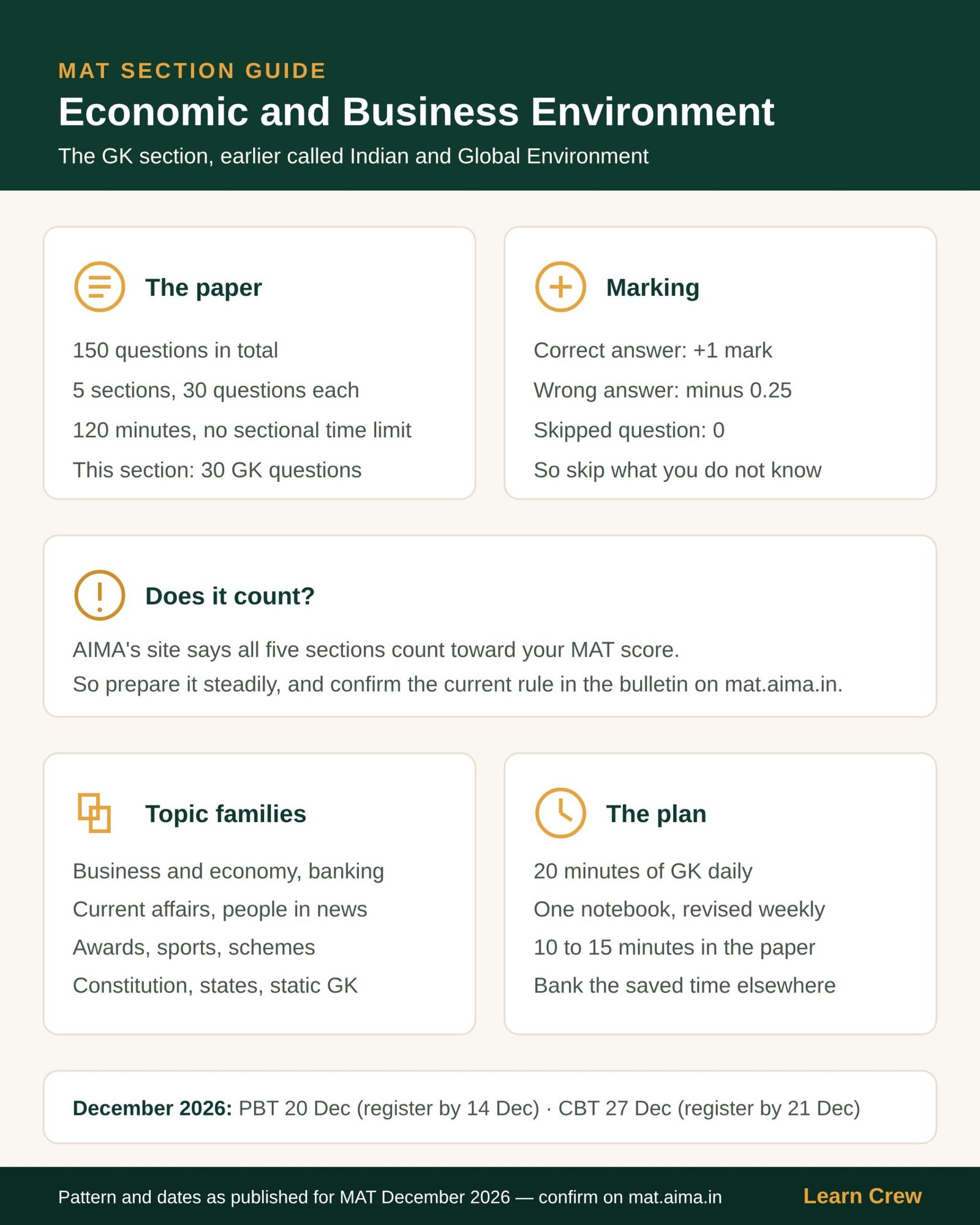
MAT has five sections, and Economic and Business Environment is the general knowledge section. Many websites and older books still call it the Indian and Global Environment section — it is the same thing. The paper has 150 questions in total, 30 from each section, and you get 120 minutes for the whole test. Every correct answer gives you 1 mark, a wrong answer takes away 0.25, and a skipped question costs nothing.
How is it scored? AIMA’s own site keeps it simple: all five sections count toward your MAT score. You will still find prep forums and older guides saying the GK score is shown separately and left out of the percentile — that is how the section was often described in the past. Do not build your plan on that hope. Treat it as a section that counts, and confirm the current rule in the official bulletin on mat.aima.in. For how the composite score out of 800 and the percentile are built, our guide on how the MAT composite score and percentile are calculated walks through it step by step.
So should you skip it? No — but prepare it smartly
Many students ignore this section completely because coaching forums keep calling it the section that “does not really count”. That is a risky bet, not a strategy. The score appears on your scorecard, a college can see it, and AIMA’s site says it counts. Some institutes may also look at it while shortlisting, so check the admission pages of the colleges you are applying to. And the same general knowledge comes back later in the selection process — group discussions, essays and interviews lean heavily on current affairs and business news.
The smart position is in the middle. Do not spend your best study hours here, and do not burn paper time here. But keep a light, daily GK habit running, attempt what you know in the exam, and let the section quietly add to your profile instead of dragging it down.
The topics the 30 questions come from
AIMA does not publish a question-wise break-up, and the mix changes a little from paper to paper. But past papers keep drawing from the same families. On the business side: the economy, companies and brands, banking and money matters, taxes and duties. On the current affairs side: events of the last few months, people in the news, awards, sports, and government schemes. And on the static side: the Constitution of India, states and capitals, geography basics, and well-known books and personalities. If you want the topic lists for all five sections in one place, our MAT syllabus guide covers them section by section.
A 20-minute daily habit beats a GK marathon
General knowledge cannot be crammed in a weekend. It builds the way a language builds — a little every day. Twenty minutes is enough. Ten minutes on a newspaper or a good news app, with extra attention to business and economy stories. Five minutes writing down three or four points in a small notebook — names, numbers, who did what. Five minutes revising last week’s notes. That one notebook, revised weekly, will quietly cover most of the current affairs questions.
For static topics, keep one small source and stick to it. One chapter a week — the Constitution this week, states and capitals the next — is plenty. The common mistake is collecting five GK books and ten PDF compilations and reading none of them twice. One source, read twice, beats five sources read once.
How to handle it inside the paper
This is the one section where you cannot “work out” an answer. You either know it or you do not. So it should take the least time of all five sections — 10 to 15 minutes is enough. Go through the 30 questions in one quick pass. Answer the ones you know. Skip the rest without guilt, because a skipped question costs nothing and a wrong guess costs 0.25. Blind guessing has no upside here: you cannot narrow options by working, so a guess is a pure coin toss against negative marking, and the guessing habit spills into the other sections where it does more damage.
The real gift of this section is time. You cannot “think” your way to GK answers, so it will always be your fastest section. If you finish it in 10 minutes, you have banked extra minutes for Mathematical Skills or Data Analysis, where working time turns directly into marks. Treat the GK section as a fast, calm warm-down, not a battle.
A simple routine before the December exam
The December 2026 session has been announced with the paper-based test on 20 December and the computer-based test on 27 December. Registration for the PBT closes on 14 December and for the CBT on 21 December — always confirm the dates on mat.aima.in before you plan. That leaves about six weeks from today, which is enough to build a GK base if you start the daily habit now.
A workable plan: start the 20-minute daily routine today and do not break it. Each weekend, revise the week’s notes and one static chapter. From the second week, add one 30-question GK sectional test a week, done in 15 minutes, to learn what “know it or skip it” feels like under a clock. In the last two weeks, sit full mocks so the section takes its small, fixed place inside the real 120-minute paper.
Mistakes that cost marks here
Four mistakes appear again and again. Skipping the section in every mock and then freezing on it in the real paper. Cramming a six-month compilation in the last week instead of reading a little daily. Guessing blindly because “it does not count anyway” — AIMA’s site says it counts, and the negative marking shows up on your scorecard either way. And spending 25 minutes here while the sections that build your composite score sit waiting.
Where to go next
If you want this section — and the other four — prepared under guidance, see our MAT online coaching for 600+. Classes are live in the evenings, every class is recorded, and mocks and mentorship are included. For what past students have managed, our results are here — a MAT high of 771/800, with 9 of 10 students crossing 600.
MAT books, e-books and mock tests
The MAT book set covers Logical, English, Mathematics and Data Interpretation, printed A4 and couriered across India. The e-book and the scored mock series are on the same store, so you can pick print, digital, or both.